
Home » Journal Articles » Vein of the Community
The way veins give marble its unique character, Renée Roberts provides the vital structure that holds NWSSA together. With a keen eye for detail and a deep love for the subtractive art of stone sculpture, she’s been keeping our network, logistics, social media–and sanity–intact since 2011.
We sat down with Renée to talk about her journey from carving plaster blocks with a butter knife to her current focus on intimate alabaster and soapstone work, and what it’s really like to be the engine behind NWSSA.
Staff: Let’s start by learning how you got into stone carving…
Renée: I studied fine arts in college, focusing primarily on painting and scientific illustration. As part of the degree, you had to take a class in every track, which meant sculpture. I kept putting it off because I thought sculpture just meant clay, and I hated getting cold clay under my nails.
Finally, in my last year, I couldn’t avoid it anymore. The class was taught by Marv Herrard, a bronze sculptor. His first 3D assignment was simple: fill a milk carton with plaster, let it set, and carve it into something that wasn’t square.
Another student and I finished it in two days instead of two weeks. Realizing we were moving too fast, Marv pivoted. He had us pour another block of plaster, but this time, he swirled dry pigment through it without mixing it completely. Our mission was to carve the block while following the internal “grain” of the color.
That was my lightbulb moment. In my watercolor paintings, I was constantly using masking fluid to preserve white space—my brain was already wired for negative, subtractive thinking. Suddenly, sculpture clicked. Shortly after, I found some soapstone at Artists & Craftsman Supply in the U District. I bought a chunk and carved my first few pieces using a butter knife and my dad’s woodworking gouges. I got terrible blisters, but I was hooked.
Staff: How’d you find the NWSSA?
Renée: Years later, while working a standard office job, I picked up a catalog for the Pratt Fine Arts Center, saw a listing for stone carving, and decided to dive back in. I took a few classes from Suz/Kalia, then a few more from Sabah. Sabah Al-Dhaher is incredible and has brought so many members into our fold.
One summer session, Sabah suggested a road trip. He drove our class up to Mount Vernon to check out an NWSSA symposium at Camp Brotherhood. We had a picnic lunch on the grass while all the resident stone carvers went up to the lodge. We just sat there in awe, looking at this field of people doing exactly what we loved to do—big stones, little stones, everything.
Tom Francis was instructing that year, teaching people how to carve Featherstone (pumice). He handed us a chunk, showed us the basics, and we were off. Alex Morosco was there repping tools, and I bought my first real chisel. I also bought a very large, incredibly hard rock from Randy Zeiber, at Neolithic Stone, that was way tougher than I anticipated! I joined the association right after that weekend.
Staff: Now, you’re the operational cornerstone of the association. How’d that happen?
Renée: A callout went out on the listserv stating the association needed an office assistant who knew databases, marketing, and design. I immediately messaged back: “Me, me, me! You need to hire me!”
It was actually a little intimidating. I had to do a panel interview with Carl Nelson, Ken Barnes, Gerda Latti, and a few others. They were all lined up on one side of the room, and I was in the hot seat. They started with friendly background questions about stone carving. Then Carl leaned forward and rattled off a string of raw HTML formatting tags, asking, “What does this mean?” and I blurted out, “A bulleted list?!” Carl smiled and said, “Ok, you actually know code.” My graphic design background came in handy that day–I got the job, and I’ve been here ever since. It’s the perfect way to blend my business skill set with the creative world I wanted to live in.
Staff: When you do get time to carve, what’s your creative sweet spot?
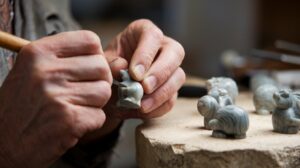
Renée: I lean toward tabletop or palm-sized pieces in soapstone or alabaster. Because I don’t own my own air compressor, my style is shaped by my tooling and my space. Working small means I don’t need loud, heavy power tools. A Dremel or a Foredom works beautifully, but honestly, I just love the physical rhythm of manual tools. I have an awesome, long diamond rasp that looks like a farrier’s horse rasp, and there is something incredibly satisfying about shaping a soft stone quickly by hand.
Staff: Share the first specific piece of advice from the community that you can think of–go!!
Renée: Pat Barton really impacted why I make small things. Pat champions the idea of functional, small-scale work that keeps an artist sustainable. He creates these gorgeous stone planters with carved flowers or custom stone vases. Everyone has a piece of Pat’s work in their house—usually multiple pieces! They are accessible, beautiful objects you can sell at an art fair for $100 or $200. Doing that allows you to fund your “stone habit,” giving you the capital to buy better tools and more stone. It’s practical creativity.
Staff: What logistical stuff happens behind the scenes that maybe we don’t know about?
Renée: The logistics are immense. First, we have to conceptualize the event and put it into concise words for the listserv, social media, and the website. Then comes the administrative infrastructure: securing event insurance, arranging pedestal transportation, and organizing setup volunteers.
For the gallery shows, I gather every single piece’s title, material, and price from the artists to print individual sculpture tags before opening night. For a week-long symposium, it turns into full hospitality management—handling complex room assignments, managing registration tiers, and tracking arrivals.
Staff: How can we help?
Renée: Volunteering time is the biggest one. It takes a massive amount of physical power to set up and break down a week-long symposium. We string hundreds of feet of water lines and electrical cords through the trees for the carving fields, the tool library, and the power tents.
If you don’t have the physical strength for heavy lifting, that’s completely fine—we also need people to sit at the welcome tables or help manage the rush when the public arrives for workshops. Even if you live far away, you can contribute by donating a piece to our auctions, helping call and welcome brand-new members, or even by taking our standing online community survey. This is your community.
Staff: Finally, what keeps you here?
Renée: This group of people is completely unique. I don’t know if it’s because we work with earth and stone that everyone is so incredibly grounded, but it is a remarkably giving community. In many other art circles, people can be protective or secretive about their techniques. You don’t see that here. Everyone has an unmistakable personal style, yet those same artists will happily hand you their tools and explain exactly how they achieved a specific technique.
If you’ve never been to an event, my only advice is: just come check us out. Walk onto the field. Whether you’re a master sculptor or someone who has literally never touched a chisel, you are on the exact same level here. Everyone is welcome.
………
Renée Roberts carves in Seattle, WA. You can find more of her work at www.renee-roberts.com.



We need some kind of descriptive text here.