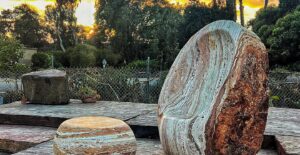
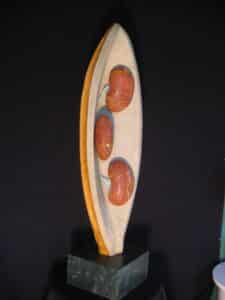
For many in the Northwest Stone Sculptors Association, Arliss Newcomb is more than a veteran member; she is the connective tissue of the community. Known for her warmth, her “multi-stone” sculptures, and a legendary ability to recruit new carvers, Arliss has long been a pillar of the organization.

Arliss didn’t begin her journey with stone until she was 60 years old. Before the “click” of the chisel on alabaster, she spent 25 years as a professional woodcarver and silversmith. Her transition to stone was sparked by a chance encounter on Salt Spring Island nearly 40 years ago. After wandering into the studio of a world-renowned Canadian sculptor, she was handed two pieces of stone and a challenge: “If you can carve wood, you can carve stone.” By the end of that summer, she had sold her first two pieces. “I have not touched wood since,” she laughs.
Beyond her personal practice, Arliss’s legacy is defined by her advocacy for others. She founded the Women’s Hand Carving group to provide a space for women to overcome the intimidation of a traditionally male-dominated craft. She has introduced dozens of members to the NWSSA, driven by a deep-seated belief that “art saves lives”—a sentiment she knows intimately, having turned to sculpting as a lifeline during the illness and eventual loss of her first husband, John.
Today, Arliss continues to carve from her home in Prescott, Arizona. In the following interview, we discuss her history with the organization, the lessons she’s learned from the masters, and her hopes for the next generation of carvers.
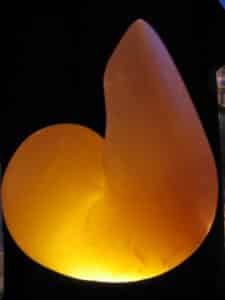
NWSSA: You’ve mentioned that the NWSSA felt like “heaven” the first time you stepped into a symposium. What was it about that first experience in 1993 that hooked you?
Arliss Newcomb: I didn’t know there were other people that did what I did! George Pratt was the first person I met, and he was so gracious. Then Marge Hunt and Meredith Earls took me under their wing. I was pretty stressed back then, and those days at Camp Brotherhood were absolute bliss. The caring and comfort of this group carried me through some very bad times. It really is my family.
NWSSA: You came from a background in professional woodcarving. How did that community compare to the culture you found here?
Arliss: It was night and day. I belonged to international woodcarving organizations that were very world-class but very competitive. I remember asking a prominent woodcarver how he got a certain finish, and he told me, “That’s my secret formula.” At NWSSA, I’ve never had anyone say a technique was a secret. People share their expertise, their knowledge, and even their mistakes. There are no egos here.
NWSSA: One of your early mentors was the legendary Uchida-san. Is there a specific piece of advice from him that still resonates in your studio today?
Arliss: Oh, absolutely. When I first started, I was very “anal”—very detailed because of my woodwork. Uchida-san came by, picked up a 30-pound piece I was working on, looked at it from all sides, and said, “More simple.” He was right. You can get your vision across without too much detail. That was tremendously freeing.
NWSSA: You’ve worked on everything from small, intricate houses to a 900-pound public art piece for your 70th birthday. How does the process change when you scale up like that?
Arliss: Technically, the big pieces were actually easier in some ways because I saw them so clearly in my head. My husband had a backhoe, which acted like a crane to turn the stone over! But as I get older, I have to acknowledge limitations. The doctors say nothing over 35 pounds, though I usually “fudge” it and start at 50. I do miss my hydraulic table, though—it’s an invaluable tool for changing heights and moving stone into a pickup truck.
NWSSA: You also founded the Women’s Hand Carving group. What was the catalyst for that?
Arliss: Years ago, women were often relegated to roles like secretary or treasurer, not teachers. I wanted women to have a voice. So many women told me they were intimidated by the “big stuff” the men did, or they were told stone was a “man’s thing.” I wanted to show them that women can do anything men can do. Seeing the “sea of women” carving together at events has been one of my proudest achievements.
NWSSA: You’ve often spoken about the “story stones” you saw early on. How does that narrative approach influence your advice to new carvers?
Arliss: I learned early on that you have to put your heart and soul into the finished product. I remember watching a sculptor who wouldn’t even wear gloves because he said he couldn’t feel the stone otherwise. While we all have to be careful with our hands and stay safe in the studio, that idea stayed with me—that you have to really feel what you are doing. You have to be connected to the work.
NWSSA: What would you say to a young person just picking up a chisel for the first time?
Arliss: I’d tell them about this marvelous organization. Other places might teach you how to sculpt, but they don’t have the cohesiveness we have. My advice? Don’t let anyone intimidate you. You are your own person. If you have a passion for stone, find the people who will nurture it. This organization is 35 years old and still going because we help each other. If you’re artistic and you’re looking for a community that shares everything they know, you’ve found it. SCULPT PROUD!!
……. …….
Arliss Newcomb is a distinguished multi-disciplinary sculptor whose career spans over four decades of material exploration. Formerly a resident of Port Townsend, Washington, she now operates out of her central Arizona studio, where she specializes in the delicate balance of marrying diverse geological textures within a single form. A regular participant in the Prescott Area Artists Studio Tour and a frequent collaborator with mixed-media artists, Newcomb’s work is characterized by a refined visual literacy and a technical mastery of diamond-tool carving. Her sculptures are held in numerous private and public collections across the Pacific Northwest and the Southwest.
Where to See Her Work: Arliss’s current sculptures are on permanent display at ’Tis Art Center & Gallery in historic downtown Prescott, Arizona. You can also view her latest work during the annual Prescott Area Artists Studio Tour each fall, or find select pieces through the Mountain Artists Guild and the NWSSA Member Gallery.