Around the Next Bend: Carving as a Form of Exploration

Sculptor John Strohbehn's current practice focuses on the transformation of raw stone and wood into refined sculpture.
Cover SNW Q1 2026 John Strohben Pink stone on burnt fir

By John Strohbehn

I’m never too sure of myself when I start a new stone carving. It takes me a few stray cuts to find a rhythm. And then the question of when to stop?

I grew up in the small town of Dayton, in Southeastern Washington. It was a place of endless rolling hills marked with the tools of agriculture. The winding roads that cut through a windswept maze of ancient loess soil and layered basalt echoed an endless question. What’s around the next bend? To my parents’ horror I ran away (or disappeared) from home a lot as a kid, mesmerized into motion by that question. In hindsight, a rock, hammer and chisel might have controlled that wanderlust, but it would take thirty-five years for me to start a carving practice. Once I started, I discovered carving created the same feeling of exploration I remember embarking on as a kid.
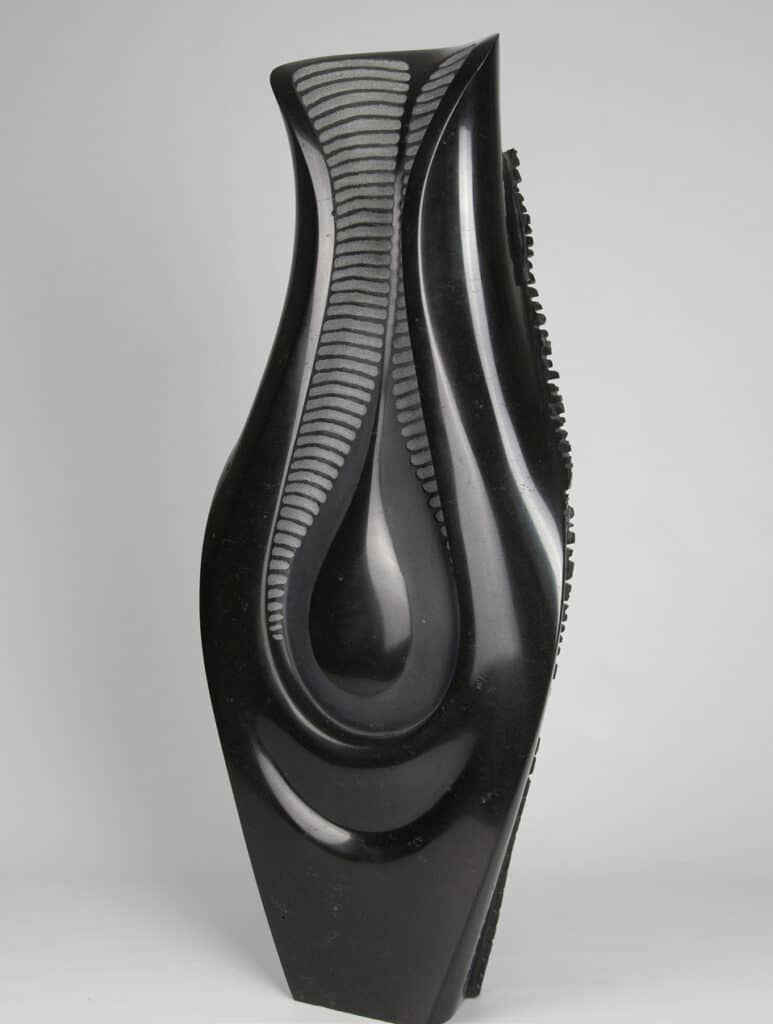
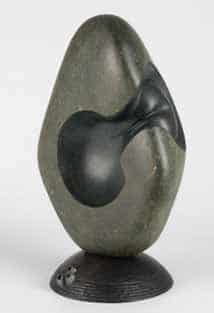
Specific Gravity’ basalt.
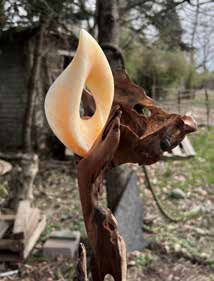
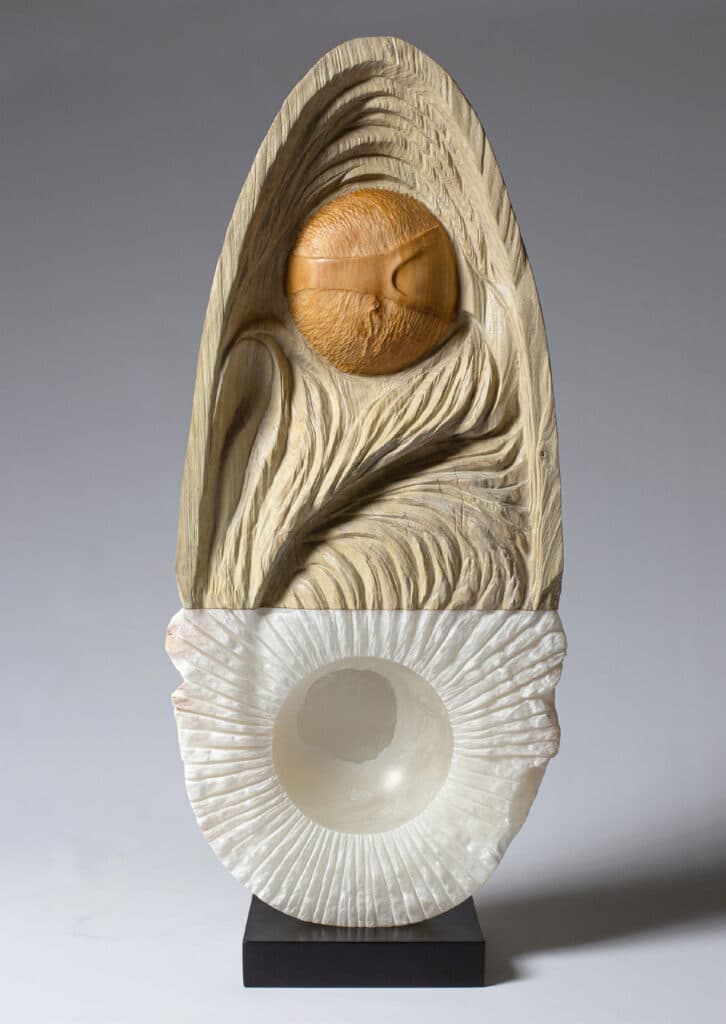
‘Harvest Moon’ , Translucent white alabaster, carved and bleached cypress wood.

After High School I bounced around the inland northwest before settling in Bellingham Washington. I attended Western Washington University after being accepted into the classical guitar program. Music was my main interest through my 20’s. During this time I also got a part time job as a sign maker which somehow turned into a full time graphic design career. I had no experience working with computers but when my boss had to suddenly leave for a month I was asked to do the design work. Never one to say no I jumped in and did the best I could…for the next couple decades. This led to my first adult crisis as a creative. I didn’t have enough time to do all “the things” I was interested in. I would need to narrow my focus.

Money was a motivating factor so I chose the job, quit the music school and looked for a way to finish college. That path was in fine arts where I gained some visual literacy in the painting department to complement the graphic design skills I was learning on the fly. At work, I eventually got pigeon holed behind a computer chasing ideas and deadlines. Although I did learn how to manage the discomfort of the creative process at mass, I was drifting towards burnt out. As fate would have it, I was drifting towards an island in the middle of the Pacific Ocean! I followed a girl who’s now my wife and I’m not sure I would have found my love for carving without finding my love for her.

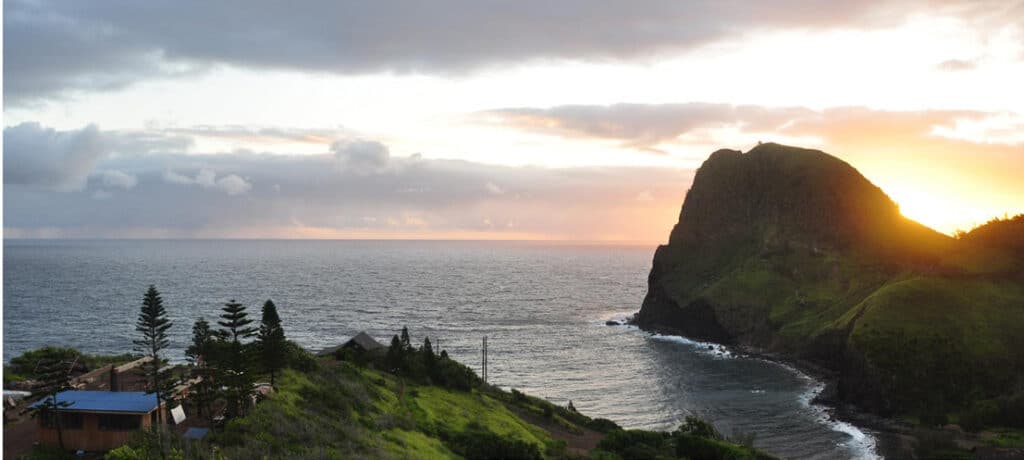
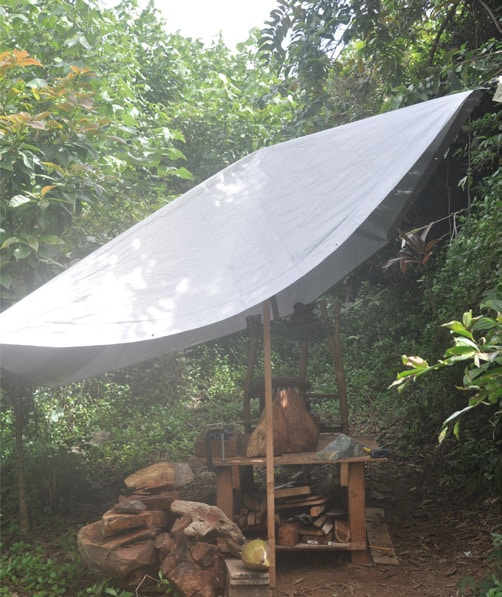
After living on Maui for a few years I was feeling an urge to make things with my hands. I was invited to help a friend put a roof on an artists studio in a remote village on the island. The artist was sculptor Bruce Turnbull who had lived and was living a sculptors life. There was evidence of it everywhere carved into the steep property he perched on like a hawk. One weekend surrounded by his art, teaching, and life’s work, knocked a screw loose in my head.  All of a sudden I was overwhelmed with an inner urgency to start something, anything. That feeling still overwhelms me and my best response to it is, “Get to work, let’s see what happens.” Bruce encouraged me to try sculpture and that’s all it took, an invitation to the party. When I got home I immediately bought a chainsaw and found some carving wood on craigslist. My first studio began under a tarp overlooking a jungle gulch infested with mosquitoes. Looking back I’m amazed at the work I was able to create with a cheap angle grinder, a chainsaw and a hand held drill. I learned that stubborn determination and bug spray were probably going to be my most reliable tools.

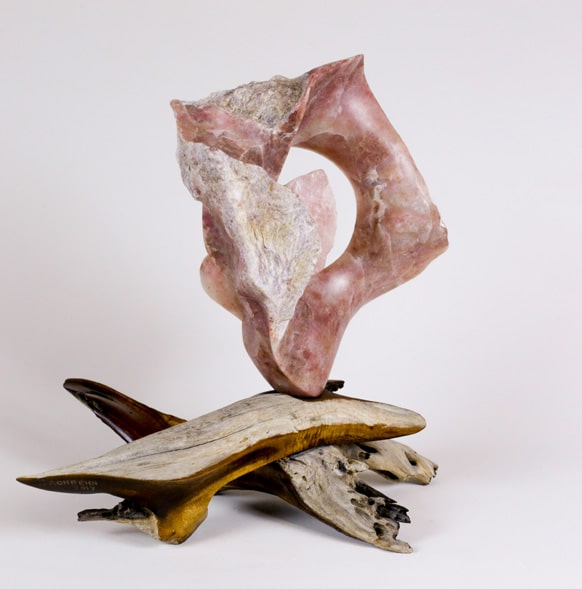
"Rekindle" Alabaster, rose quartz & driftwood

Over the next couple of years I developed a friendship with Bruce, going out to work on projects and sculptures, soaking up as much as I could. My first experience with stone was in making bases for wood sculptures. It wasn’t until my wife and I moved to the Big Island that I completed my first works in stone. The stones were pieces of alabaster and calcite Bruce gave to me and said, “Do something with them, don’t make me take them back from you.” He also told me about an organization called the NWSSA that puts on a symposium that I need to go to. The seed was planted. It would be 10 years later and a couple of big moves before I found myself living back in Washington with the opportunity to go thanks to the Karen Ryer Scholarship in 2024.

The greatest influence I’ve had in my stone carving practice is by far the NWSSA Symposium. What a wonderful group of humans to get to know. I learned more about stone in five days at Pilgrim Firs than I had in fifteen years. I brought a few pieces of basalt and a bundle of nerves with no plan of what I was going to do with either. When I arrived Markos Weiss greeted me with a warm hug that made me feel welcome. Everyone shared generously with their energy, experience and tools. By the end of the week I had made a mess of my stones but was more determined than ever to carve the hard stuff. I learned just as much at the 2025 symposium and feel grateful for all the people who’ve helped me find my way as a stoner.

Techniques and tools I learned carving wood have informed my stone carving and vice versa. I usually start my days slowly by looking, sketching, rearranging and drawing. Basically working up the courage to start. Drawing happens on paper and on the stone as I take mental notes.  It’s a thrill to be surrounded by all the possibilities. It can take a split second or years to see a way into my raw materials. Through planning, mistakes, taking a little off here, too much off there, whacking it in half, gluing it to something else…art happens. With that said, I’ve learned that hard stones demand more planned intention. The extra time I spend laying out an idea helps the work develop faster and still offers plenty of space for improvisation. Moments of decisiveness usually come from the corner of my eye during mundane tasks like cleaning the shop.

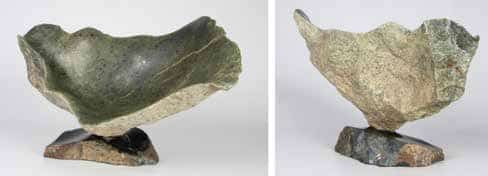
‘Olivine Oyster’- Olivine on black serpentinized olivine.

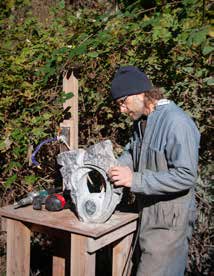
My stone tools are very basic, centered around electric angle grinders, die grinders and willpower.  Since I’ve started attending the NWSSA symposium I’ve learned a lot more about tools and my limitations. This has given me the confidence to grow my stone carving set-up. Most of my tools currently fit on a cart I wheel outside next to a wooded area where I can carve stones up to about 300 lbs. Because I’ve had a few big moves since I started carving, dragging all the weight of a sculptor’s potential with me, I look forward to settling down to a permanent space. I dream of that as an opportunity to scale up my capabilities.

‘Low Tide Marker’, Basalt, chlorite and walnut wood
Nest

I’m often looking around the next corner and tinkering with influences to learn new ways of working with my materials. My sculptures vary in style, but a strong use of line is something that has stayed continuous in my work. When the opportunity arises, I may hint at something representational in my sculptures. But they are mostly abstract with seductive tendencies, begging to be admired for their transformation from the mundane.

I’m thankful to get the opportunity to share the excitement I have for sculpture. It’s been a blessing to get to know the NWSSA community and participate in an organization that’s developing a strong carving community.

John Strohbehn is an artist who grew up in Eastern Washington. His path in sculpture started in Hawaii and has taken him to the Olympic Peninsula of Washington state. A 2024 Karen Ryer Scholarship recipient and member of the NWSSA, John’s current practice focuses on the transformation of raw stone and wood into refined sculpture. His work can be viewed on his website: johnstrohbehn.com.  Instagram account @jstrohbehn

Log In

We need some kind of descriptive text here.