By Alison Jean Cole, Principal Investigator (with NWSSA Co-Conspirators)
Glue is perhaps the least-broached subject in the craftsperson’s world, particularly amongst the stone community. However, if you ask around, you’ll find almost everyone utilizes adhesives in their process at one point or another. If you prod further, you’re likely to discover that few people feel confident about their choice in glue and even less confident regarding its applications. Almost everyone has questions, but few people have answers. At the 2025 symposium at Suttle Lake, the author (Alison Jean Cole) and her co-conspirators became aware of the aura of question marks surrounding glue. Thus began their quest to find out what glue do you use?
To our delight, thirty six craftpersons responded to a glue survey that the authors put together, and the results were illuminating! Here they are at a glance:

It turns out almost everyone uses some sort of glue at some point in their process. The majority of respondents were stone sculptors, and a few lapidaries and metalsmiths weighed in, as well. More than three quarters of respondents said they used adhesives to glue stone to stone, as well as metal to stone. A few outliers used adhesives to glue ceramics to stone, glass to metal, and so on.
The top three uses of glue amongst respondents were:
Some sculptors said they use glue when pinning and sleeving, and many said they employed it to hold something in place temporarily. A few outliers (mostly the jewelers) responded that they use adhesive for intarsia and inlay, or mounting jewels in bezels and prongs.
So, what glues are folks using? The responses were all over the map.
Let’s look at the stone sculptors first. The top choice was Starbond, which comes in three viscosities. Starbond is a cyanoacrylate adhesive–a superglue. Nine respondents noted Starbond as their first choice, making it the most popular. Starbond users positively noted its strength and longevity. Duane in Ventura commented that the thinnest viscosity Starbond “fills micro cracks and dries very fast.” However, Tamara on Lopez Island noted some concern regarding possible toxicity and Marge in Providence lamented that Starbond can be compromised by freezing temperatures.
The runner up was Akemi brand epoxy, which is available in paste (also known as “knife-grade”) and gel form. Epoxies are more complex than superglues, hardening through a chemical reaction between resins and hardeners. Akemi users praised its strength, clear-drying quality, and ability to take pigments. However, Jeremy in Seattle noted that among the ranks of adhesives, the brand can be expensive. A few respondents also noted a preference for Tenax brand epoxies. Ian in Portland remarked that Tenax Rivo 15 was “viscous enough that it doesn’t drip, but still flows well to fill voids.” Meanwhile, Dan in Memphis has been experimenting with 15-minute Bondo. He positively noted its strength and quick set, but worried about its volatility and toxicity.
Carl in Lake Stevens listed “West system GFlex- 550, 610, 650, 710, and 105” epoxies in addition to Akemi “Akepox 5110” and “Tenax (titanium knife grade.)” He also listed various cyanoacrylate adhesives with differing viscosities. Of the superglues, Carl likes “Gorilla Glue, HOT Stuff – Satellite City Inc, and Starbond.” Omniciently, he noted that “each glue has its strengths and weaknesses.” Carl should be writing this article.
Epoxy 330, a two-part quick-setting epoxy, was favored by the lapidaries and metalsmiths. Respondents positively noted its low volatility, non-yellowing quality, and quick setting time. However, Caitlin in Tampa noted unhappily that Epoxy 330 “creates a lot of bubbles when mixing,” and Alison in Portland lamented its lack of longevity. “I wish I could find an epoxy that lasted decades rather than just years.” HXTAL NYL-1 was a strong runner up amongst jewelers. Bri in Pueblo mentioned that “it sets quickly, but it does yellow over time and softens.” She said that she’d “love an epoxy that doesn’t require heat to set up quicker without compromising longevity.” Cailin in Portland, who also prefers HXTAL epoxy, noted a concern about its possible toxicity. Other adhesives that made the list amongst the jewelers were E6000, E8008, and JB Weld.
It’s no surprise that many respondents raised concerns about toxicity. The complex polymers that comprise adhesives have been linked to toxicosis, cancer, and reproductive harm in studies on non-human subjects. Thus, all adhesives come with a Safety Data Sheet: an OSHA standardized document providing comprehensive information about a substance’s chemical properties, health hazards, safe handling, storage, and emergency procedures. We asked:
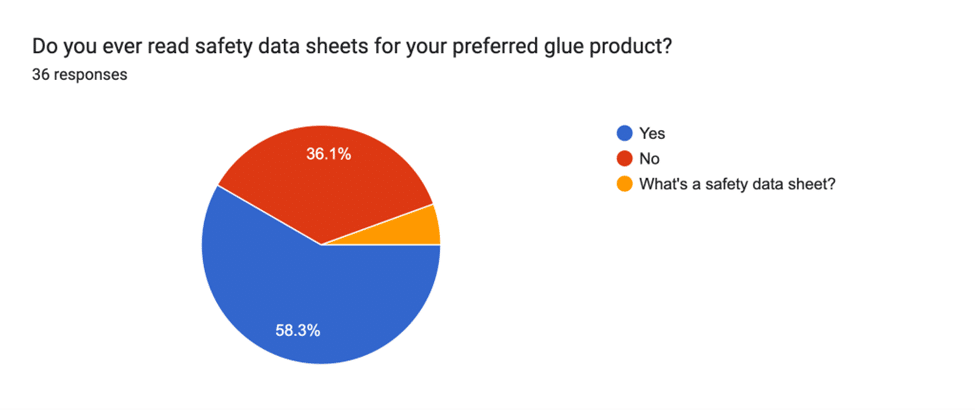
Hey, 58.3% isn’t bad, but let’s see if we can boost that number.
Almost all respondents followed up by providing information on what kind of PPE they use when working with hazardous substances like glues:
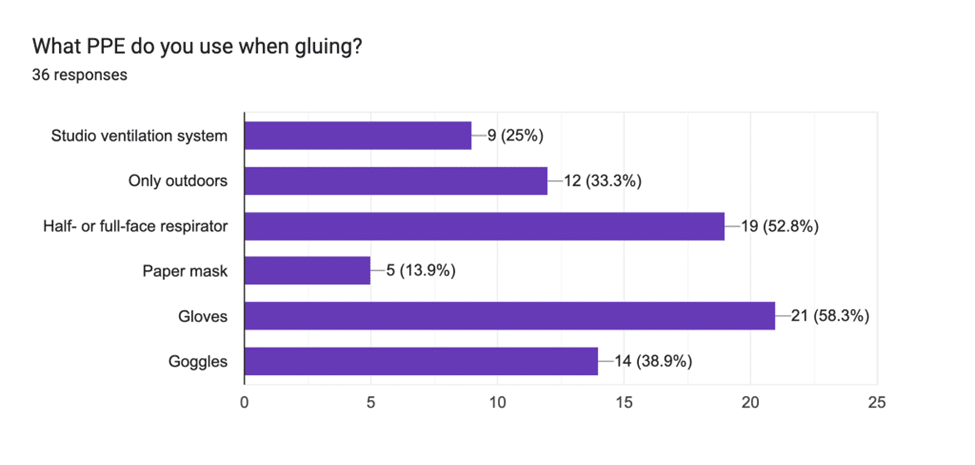
It’s a relief to see most people are using gloves and respirators. Some folks are taking it a step further and employing ventilation systems or taking the glue operation outdoors. Anything we can do to keep adhesives away from our bodies the better. Several respondents checked the box that said “I glued my eyelashes together and was very distressed.” Life with glue definitely has its woes. There were spiritual complaints, as well. Carson in Portland lamented that using glues “feels like a shortcut that diminishes the integrity of the craft in the object.” Maybe if all our work were of the highest integrity, we could forgo glue and all still have our eyelashes intact.
Many respondents further noted unfulfilled glue needs in their lives. Carmen on Vashon Island wishes to find a glue for filling cracks. Jeff in Santa Cruz dreams of an epoxy that lasts longer in the tube or ejector. Markos in Seattle wishes for the most important of all: a clear non-toxic glue for fixing a wine glass.
In the realm of glue, not all is unanswerable. Among the respondents, glue savants emerged among us. Dave in Oregon City listed almost as many glues as Carl in Lake Stevens. When prompted if there was an unfulfilled glue need in his life, Dave’s answer was, “no.”
MJ in Nehalem tuned in on the philosophical plane, offering us some wisdom. “Like life, a little epoxy can be used to fasten or repair, but too much glue means you should start over.” In our hearts we know that MJ is right, however, I think respondent Rebecca in Lawrence knows our true nature best. “I just wonder if I could use a better glue.”
Alison Jean Cole is a lapidary artist, author, and licensed outfitter guide based in Portland, Oregon. She is the author of Beautiful Rocks & How to Find Them (2024) and A Rockhound’s Guide to Oregon & Washington (2025). A former officer of the Mt. Hood Rock Club and a member of the Northwest Stone Sculptors Association, she has spent over a decade exploring the geological history of the American West. When not carving stone or making jewelry, she leads guided rockhounding expeditions through the high deserts of Oregon and Nevada. Learn more at alisonjeancole.com.