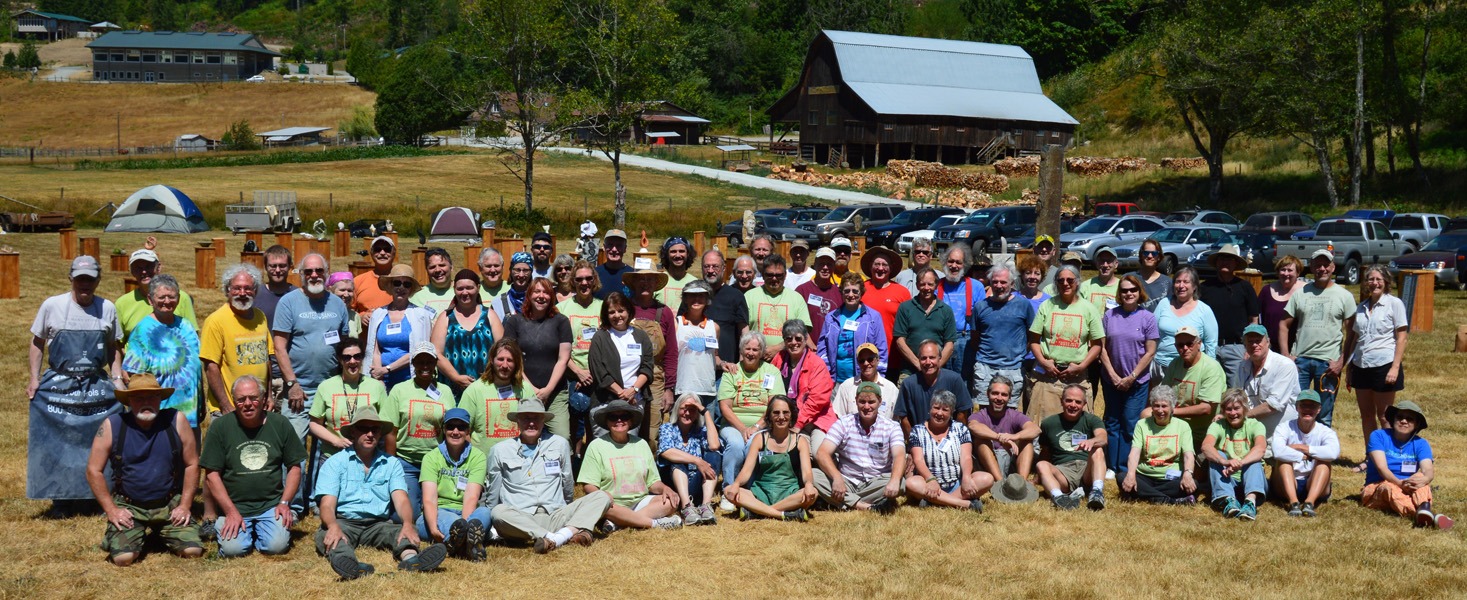
Hello, my name is Ed and I have been carving stone for ten years. I joined the NWSSA and started attending the summer symposium in 2017, the last year our event was hosted at Camp Brotherhood. I was a work-study that year, the same year that Ben Kimura and Jeremy Kester joined as work-studies. It was a great year to join our organization. I served as a work-study for several more years until I transitioned into the Field Ranger role that Pat Barton held for a long time. I have missed a couple of camps here and there while out traveling the stone road, only been to the Oregon symposium once (the year of the total solar eclipse) and with luck finally getting to the California symposium for the first time this year, so I know there are still folks I don’t know or who haven’t yet heard my story. Beyond stone camp, many of you know me as one of the “guys from Tenino”. That alone is cause for this introduction, as I am not actually from Tenino. However, it’s as good a place as any to get started, maybe even a little better than others. This, in short, is how I stumbled into stone.
Olympia is my hometown. It’s a CITY, in case you’re not familiar, a small city, but a city all the same, and a CAPITOL CITY no less, with maybe the greatest capitol building in our nation, if you like that sort of thing. I DO like that sort of thing: Buildings, sculpture, history, among other things. It was an interest in these topics that motivated me, one spring morning, to pack my bike with overnight camping gear and take a solo bike trip visiting the small farm towns that surround Olympia. I knew nothing of this area just outside of where I had grown up. Towns like Rochester, Yelm, Rainier and yes, that charming little sandstone quarry town I would forever-after be associated with: Tenino.
My first stop in Tenino was the famous Tenino Depot Museum, a former train station built from sandstone blocks and situated at the foot of the town’s centerpiece attraction, the Quarry Swimming Pool. This was, in truth, the only thing I knew about Tenino before arriving: there was a swimming pool inside an old quarry, and train museum in the park.
When I entered the museum I saw the printing press Tenino used to print WOODEN MONEY during the great depression, a press still used to this day to print commemorative wooden money you can actually spend around town. There was information on the railroads that first came through Tenino, railroads that today serve as interconnecting trails for pedestrians and cyclists, like those riding the Seattle-to-Portland bike race. And then there were photos of the quarries and the men who worked in them. Some wore bowler hats, white collared shirts and ties. They were master and journeymen carvers sculpting figures and decoration of state buildings, highly respected and dedicated to their craft, able to travel the world plying their trade. Others were quarry men, blasting and drilling through the coldest, wettest days of the year, as intense a job as there ever was. Those men were tough as nails. As I was browsing through the stone history, I came to some modern photos of a white-haired man chiseling a gray stone. “That’s Keith, the last of the stone carvers,” said the volunteer working at the museum counter. “He has a workshop just a few blocks from here, you should go see him.”
It would probably be a waste of my limited word-count to say that I did visit Keith’s workshop that day, where he took notice of my more-than-usual level of interest, and he put tools and stone in my hands and offered to teach me what he could, because I wouldn’t be writing this article if I hadn’t. In fact, I spent the next 5 years as Keith’s apprentice. It was a title I insisted on when Keith admitted he wasn’t actually a “master” and couldn’t offer me any official apprenticeship. However, Keith kept me working and learning. He gave me stone commissions and paid me to help him move stone one inch at a time. We had no heavy equipment. We moved every stone with a pry bar. We took every project out of a rough stone, we flattened every side with angle grinders and chisels. We didn’t have air power or running water or heat. Keith worked every day rain or shine (including Christmas and his birthday) except for Sunday, that was a day you spent working at home designing the next projects. I tried my best to follow in Keith’s footsteps. It was cold, wet, often brutal and always isolating work. In a few years I went from making pet tombstones to carving public monuments at the high school football stadium and the Veteran’s Memorial Wall at the Tenino City Park. Our accomplishments were regularly featured on local TV and newspapers, and in Seattle travel magazines. Local tourists began seeking us out. Before I was ready, I started teaching, first with Keith at his workshop, and later as a visiting artist in middle and high schools all over the Puget Sound. Slowly, more people started to find us and it looked like we were growing into an organization. I dreamt that I needed to start a business that could welcome other carvers into our fold, so that Keith’s knowledge and the craft of stone carving could carry on into Tenino’s future. I enrolled in the Enterprise for Equity small-business training program in Olympia. I told my small-business coach, “I’m starting a collective.” “That’s great,” she said, “but we don’t really teach about that.” I went to networking events with mayors and city council members. I joined community advisory boards and met other people trying to build a full-time business from their art. I was figuring out a way to make a career out of what I had stumbled into. I had some momentum, confidence and encouragement, and when I looked back at my professional career thus far of pushing shopping carts, washing dishes, making copies, etc it was easy to see I was one the best path I had yet discovered.
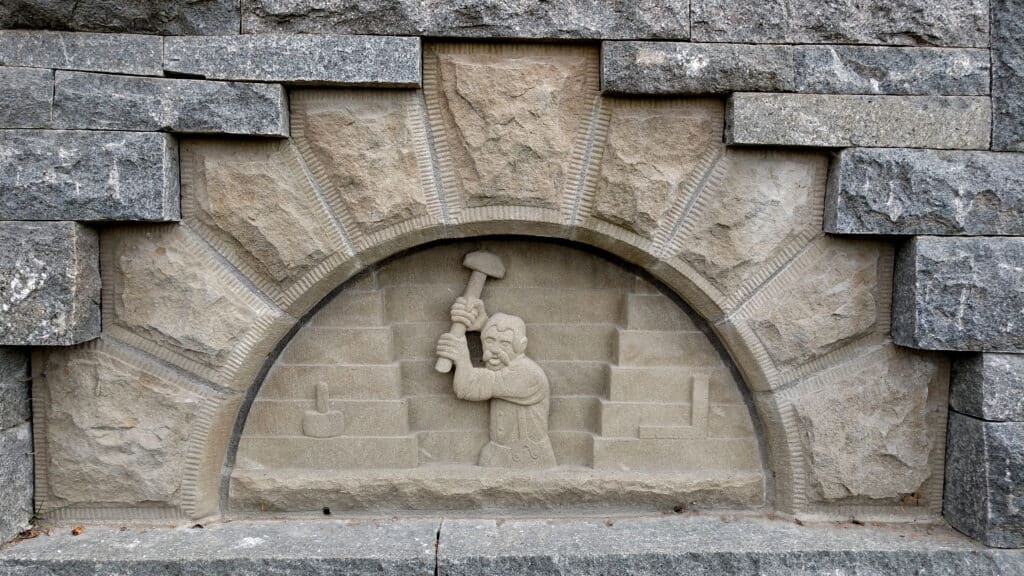
The first of four tympanums commissioned by the City of Tenino for the Veterans Memorial wall at the City Park. A collaboration between members of the Tenino Stone Carvers Guild. Bill Lenker built the wall, Dan Miller and Keith Phillips carved the masonry arches, and I did four relief carvings depicting the history of the quarry swimming pool.
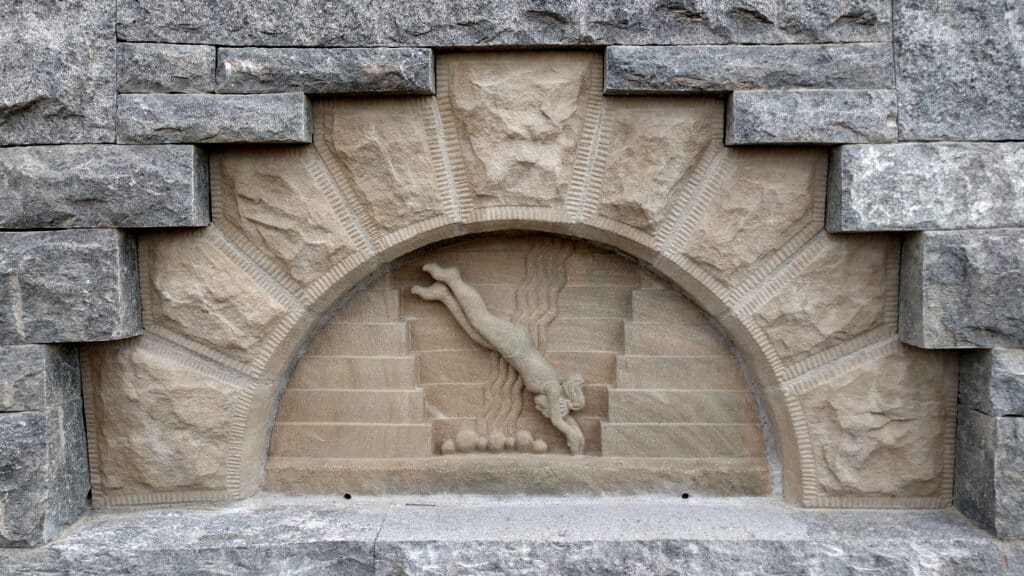
The last of the four tympanums, carved in Tenino sandstone, 2019
I did come to live in Tenino for a short time. I traveled much less, spent far less time in Olympia with friends and instead focused on the new and seemingly endless workload of designing and carving address signs, fireplace surrounds and tombstones. I met Keith and the other townsfolk for coffee every morning. I waved to the people in Tenino who all knew me by name. Not entirely ready to settle down in a such a small place, I did make one trip in those early years, to New York City. I became friends with another carver in New York named Chris Pellettieri, a story which will have to wait for another time. But what I learned from Chris over many visits to NYC, I took back with me to Tenino.
Our shed in downtown Tenino, where I first met Keith huddled in a space big enough for just one person, his corner of the building partitioned off with hanging tarps and heated with a propane camp stove, we grew that little shed together. We took over the whole building, built an upstairs, started teaching classes and filled the room with our sculpture and speculative works for sale. We were visited by governors, the President of Ireland, and the WA State Arts Commission. We grew in members, joined by English stone-mason Dan Miller, and local Olympia wall-mason Bill Lenker, local historian and carver Tony Cutler, and fellow stone sculptor Myrna Orcini, among others. Our last meeting of the Tenino Stone Carvers had 12 members present from all over Tenino, Olympia, Seattle and Centralia.
The Tenino Stone Carvers today is a growing organization moving in a lots of new directions. Dan Miller heads up the commercial division and teaches banker masonry, Bill Lenker is the director of the non-profit and has raised tens of thousands in grant-funding to secure a parcel of land next to the museum at the City Park for a future classroom and stone carving workshop. Keith, now in his 80s, still carves and just finished a years-long monument for former WA Secretary of State Ralph Munro.
Aside from a day or two in the summer for a craft fair, or maybe an occasional work-party with the guys at the quarry, I don’t go into Tenino much these days. To be honest, I found it was a difficult place for a single man in his 30s to make a life. It’s a town where almost anyone young is already settled down to raise a family on a farm. And if you’re focused on making art, you will probably have to make frequent trips to places like Seattle where there’s a bigger network of artists and clientele. But if you don’t mind the isolation, you can have endless work making address signs from Tenino sandstone if you want, and that’s really not a bad gig by any means for a carver. Maybe if I had already settled down with a family when I landed there I would have stayed. I also developed a bad case of tendinitis that has never left and plagues every physical thing I do. I have learned techniques for managing it, but it makes certain tasks very difficult.
I still carve all the time though, however I don’t do commissions or the commercial projects the other Tenino guys are involved in. Nowadays I carve my own sculpture and lettering in a garage or a backyard. I don’t have goals to grow a business, to teach, to foster a growing interest in craft. I just have simple, modest goals to carve for a hobby and grow as an artist. I still take my carvings to the Shed and attend Tenino Stone Carvers meetings and occasionally I rattle off ideas with the guys over our exciting and unpredictable future in that little town. It was, and still is, a great place to get started.
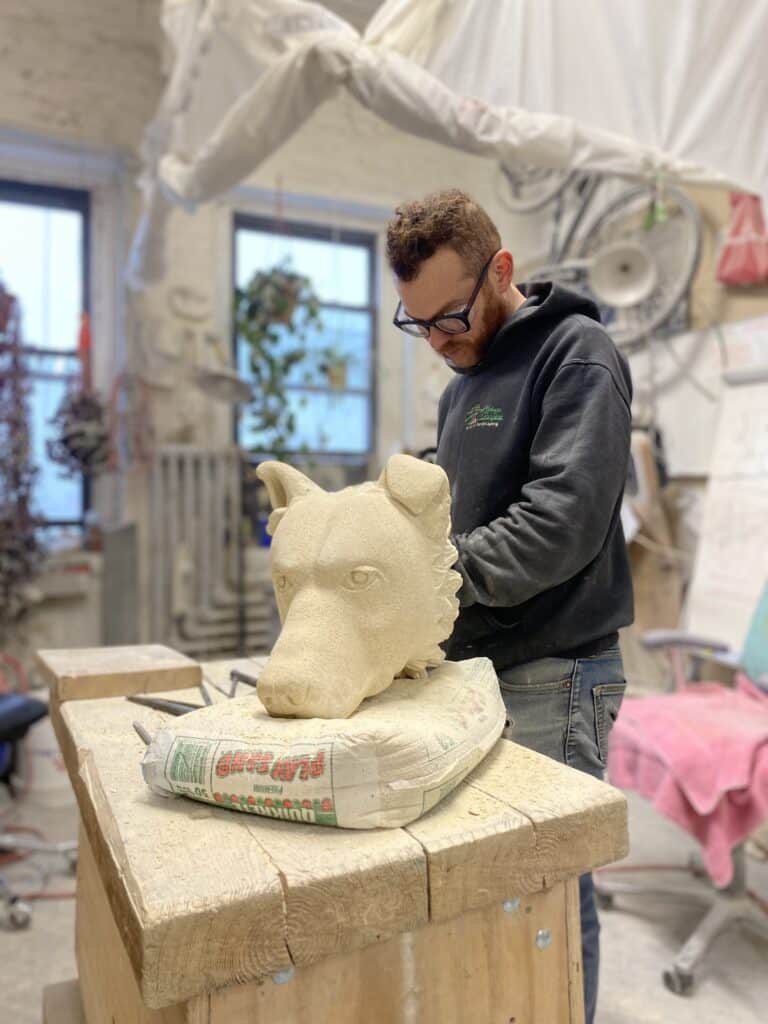
Ed Salerno is an itinerant visual artist and stone carver specializing in traditional handtool methods. A former apprentice to master carver Keith Phillips in Tenino, Washington, he helped establish the Tenino Stone Carvers Guild and The Shed, a cooperative workspace dedicated to preserving the town’s quarrying heritage. Currently based in New York City, Ed serves as an assistant teacher at the Pellettieri Stone Carvers’ Academy and is an active member of the Northwest Stone Sculptors Association. His work spans public art installations, sculptural cemetery monuments, and fine art relief carving. Find out more on EdSalerno.com